[This article was originally published in February 2011 in the Ecuadorean online art journal, La Selecta, under the title El inclasificable Eduardo Solá Franco.]
.jpg) |
|
Figure 1. Portrait of Dorian Gray (1978).
79 x 99 cm. Oil/canvas.
Private collection.
|
“I believe in God and reincarnation. Hell
is being here.” - Eduardo Solá Franco.
Last summer’s [2010] exhibition at the Museo Municipal in Guayaquil entitled, Eduardo Solá Franco: el
teatro de los afectos, (Eduardo Solá Franco: The Theatre of the Affects) contained a startling painting from later in the
artist’s career that can be read as a key, a rosetta stone of sorts, to
interpreting many of the works depicted in the show. The painting, “Portrait of Dorian Gray” (figure #1), shows a handsome, rather effeminate-looking young
man, well-dressed, with blond, curly hair and penetrating aquamarine eyes. The
subject’s right hand, extended at his side, displays long, tapering fingers. On
the pinky is a single ring with a coral-colored stone. In his left, the subject
holds a flower, the feathery globe of a dandelion gone to seed, as if waiting for
a breath of wind to disperse the fine seeds into the air and mar the perfection.
But, the elegant scene is tempered by an insidious, secondary layer to the
composition. Like a palimpsest, the surface composition appears cracked to reveal
a sinister image beneath. In this lower layer, lurking over the shoulder of the
handsome youth is a hideous old man, naked, bald, and wizened, with a sour,
downcast mouth. And yet, the old man has the same penetrating aquamarine eyes. We
realize, suddenly, we are seeing the young man’s older self, revealed in future
time through fissures in the deteriorating canvas.
“Portrait of Dorian Gray” is one of a series of unsettling paintings, all double images of a
similar macabre character. Solá Franco called them “cuadros encontrados en un
desván” (“paintings found in an attic”). They were completed when the artist
was in his late fifties and early sixties and they show his preoccupation with the
fleeting nature of youth and physical beauty. “Portrait of Dorian Gray” takes
its name from the title of a novel by the British writer—and persecuted
homosexual—Oscar Wilde. In the story, Dorian Gray is a handsome young man who, while
having his portrait painted, agrees to sell his soul in exchange for eternal
youth; under the deal he will appear forever young while his portrait ages for
him. Over the years, Dorian descends into a life of debauchery and hedonism. And
yet, the wages of his sins and his increasing age do not register on his face
or body but only on the portrait, which he is careful to hide in the attic where it will not betray the secret of his dark and withered soul.
Eduardo Solá
Franco (b. 1915, Guayaquil, Ecuador – d. 1996, Santiago, Chile) was a prolific and
multi-faceted artist, perhaps the most diverse Ecuador has ever produced. His
staggering output included not only hundreds of paintings in a variety of
styles but also sculpture, illustrations for magazines and film, stage scenery,
plays, poetry and novels, choreographed ballets, award-winning experimental
films and, perhaps most intriguing of all, a series of 14 illustrated diaries in
which he recorded, “all that
which I saw of interest and that attracted me: people, landscapes, cities,
states of being, spectacles, parties, and fashion”. He was also a public
figure—he served for years as Ecuador’s cultural attache in Rome—who mingled
with artists, thinkers, and society figures in Europe, the United States, and
South America.
However, like
Dorian Gray, Eduardo Solá Franco harbored a hidden life, one revealed only on
canvas. Solá Franco was homosexual, and deeply ambivalent about it. And yet
this concealed side of Solá Franco’s personal life was central to many aspects
of his creative output and manifested itself in myriad ways in his paintings.
Sadly, the
exhibition at Guayaquil’s Museo Municipal was on display for only one month, nor
are there plans for the exhibition to travel to other cities in Ecuador, but thanks
to a recent book by the curators of that exhibition, Rodolfo Kronfle and Pilar
Estrada, the works exhibited there and the themes raised can now be studied in
greater depth. The book, which shares the same name as the exhibition (Eduardo
Solá Franco: el teatro de los afectos by Rodolfo Kronfle Chambers &
Pilar Estrada Lecaro, Municipalidad de Guayaquil, 2010, 265 pages, $45), is a
fair representation of what was a breathtaking show. The book contains more
than 90 color plates of the paintings exhibited in Guayaquil and some 1,000
thumbnail-sized images from the diaries, as well as reproductions of
photographs and other works by Solá Franco.
This review will
look not only at some of the themes discussed in the book and the exhibition,
it will also attempt to introduce the reader to some aspects of Sola Franco’s
life and expression that the authors were unable to fully explore within the
confines of their curatorial focus.
Although it is
the first critical study to be published about Eduardo Solá Franco, it is
important to note Eduardo Solá Franco: el teatro de los afectos is not a
retrospective overview of the work of this prolific and compelling artist.
Instead it explores in detail the largely hidden and conflicted private life of
the artist through a careful investigation that correlates the subject matter
in a select group of paintings with the scenes and people described in his
writings and illustrated diaries.
The narrative of
the book wanders at times from this thesis to touch on other aspects of the
artist’s life and work. This is not surprising for in embarking on an
investigation of Eduardo Solá Franco, the authors have taken on not only a
complex subject but a largely unexplored one and they obviously felt the need
to introduce the overall man and his career. However, the book suffers from
this decision. In trying to tackle broader aspects of his career, the authors
both divert attention from their central theme while not fully exploring the vast
scope of his creative output, leaving the reader thirsting for more information
and struggling to fill in gaps in the artist’s career.
The lead article
in the book, by Kronfle, reveals the autobiographical elements Solá Franco inserted
into the paintings depicted. Kronfle masterfully draws on aspects of the
artist’s life as revealed in his diaries, photographs, and in his writings. Yet,
while Kronfle’s article is extremely well-annotated, it lacks a bibliography
that could aid future scholars. In fact, the book as a whole lacks several basic
elements. The absence of a standard chronology of Solá Franco’s life is keenly
felt and while the book does contain an innovative biography using Solá
Franco’s photographs and sketches, this lacks detail and is difficult to use. The
book contains no listing of exhibitions leading the reader to believe Solá
Franco received little recognition in his lifetime while in reality he had nearly
30 solo exhibitions, some at prestigious galleries in Europe and the United
States. Astonishingly, the book contains neither a catalogue of the works reproduced
nor an index. At more than 250 pages, this lack of an index is particularly
vexing when trying to locate images of works mentioned in the text. For a book
that must have been costly to produce, featuring luscious reproductions and
carefully researched articles, the absence of these contents essential to any
serious art book today, is a surprising omission.
The book’s
second article, by Museo Municipal de Guayaquil director, Pilar Estrada, presents
a concise overview of Solá Franco’s portraits. It is in this fine article that
the reader first realizes the book—and the exhibition on which it was based—is
not, in fact retrospective in nature. Rather, Estrada explains that the works
displayed represent a highly subjective selection. As such, the book does not explore
the full breadth of this prolific artist’s work. Estrada’s article reveals, for
example, that while Solá Franco produced an estimated 150 commissioned
portraits—an important source of income for the artist—the portraits
investigated in the book come almost exclusively from his private collection. Many
are of Solá Franco’s former lovers, possible lovers, and other close, personal
friends and, as such, they shine a light into the private attic (desvan) of his
life.
These portraits
also allowed a freedom of expression for Solá Franco not afforded by
commissioned works. As Estrada writes, “La forma de produccion, pro fuera
de los encargados, demuestra como la manera de percibir a sus conocidos, en
cuanto a apreciaiciones subjetivas, tiene una capacidad de proyeccion mas
profunda en este tipo de retratos, que lo que podria encontrarse en los
comisionados” (“The form of production, beyond those commissioned works, shows
the manner in which he percieved those he knew well, as subjective
interpretations, with a deeper capacity of projection in these portraits than
can be found in the commissioned works”).
Artistic Dialogues: New York City and Paris
A third article
in the book, by Maria Helena Barrera-Agarwal, deals with the young artist’s
years in New York in the 1930s and a brief sojourn in Hollywood in 1939. Entitled, “La metropolis como punto de
partida” (“The Metropolis as Point of Departure”), the article suffers from an
excess of detail and a failure to explore the artistic influences Solá Franco encountered
in New York. Rather than throb to the beat of the metropolis, mundane details slow
the article to a crawl. Five pages of text, for example, are devoted to Solá
Franco’s few short months in Hollywood toiling for Paramount Pictures and the
Walt Disney Company. This episode could have been significantly condensed while
still conveying the impact—not all of it positive—on his later creative life.
While the article argues friendships Solá Franco made in New York were central
to his initial success as an artist, it leaves the reader with the impression he
somehow remained largely untouched by the profound artistic and intellectual ferment
in the city during his sojourn of nearly five years.
When Solá Franco
arrived in New York, in the summer of 1935, the city was second only to Paris
as an artistic center; by the time he gave up permanent residence there in
1940, New York—thanks an influx of artists fleeing war in Europe—was the art
world’s undisputed capital.
Solá Franco
studied at three important art schools in New York, the short-lived Grand Central
School of Art, The New School for Social Research, and the Art Student’s League,
but the reader learns only about his time at Grand Central and, even here, gets
almost no information about his teachers or fellow students. Nor does the
reader get even a hypothesis as to how Solá Franco interpreted—and was
influenced by—the artistic trends sweeping the city.
The article also lacks exploration into the connection between Solá Franco and his fellow Ecuadorean, Camilo Egas, under whom he studied in 1936 and 1937. By 1935, Egas was in the front rank of Latin American artists in New York. His murals for the New School, along with works by Diego Rivera and Jose Clemente Orozco, the Mexican muralists, helped define Latin American art for New Yorkers. Egas would go on to have an even deeper impact on New York’s art scene as an instructor at the New School and as director of its influential art workshops, shaping the city’s young artists for more than three decades.
The article also lacks exploration into the connection between Solá Franco and his fellow Ecuadorean, Camilo Egas, under whom he studied in 1936 and 1937. By 1935, Egas was in the front rank of Latin American artists in New York. His murals for the New School, along with works by Diego Rivera and Jose Clemente Orozco, the Mexican muralists, helped define Latin American art for New Yorkers. Egas would go on to have an even deeper impact on New York’s art scene as an instructor at the New School and as director of its influential art workshops, shaping the city’s young artists for more than three decades.
While the book explores in depth the influence of the Catalan symbolist painter, Ramon Lopez Morello y Meléndez, on the young Solá Franco, the lack of investigation into the influences left by Egas and other artists leaves the reader struggling to understand the creative antecedents that shaped this most versatile and stylistically eclectic of Ecuadorean artists.
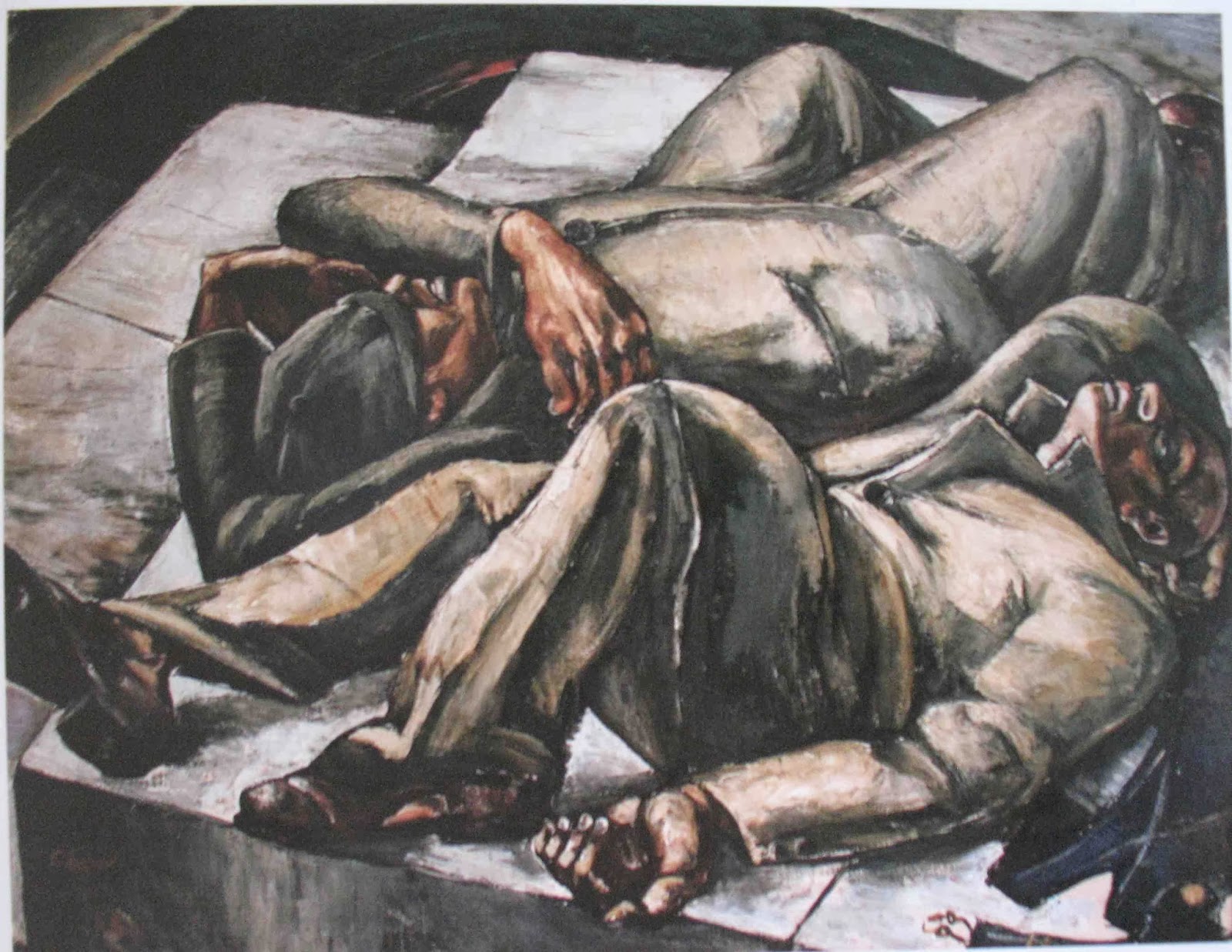
However, Eduardo Solá Franco: el teatro de los afectos benefits from the inclusion of more than one thousand tiny, thumbnail images reproduced from Solá Franco’s diaries and photo albums. From these images, the reader can begin to piece together answers to the questions raised above. Among the most compelling is a tiny image that appears on the invitation to the opening of Solá Franco’s 1955 exhibition at the Van Diemen-Lilienfeld Galleries in New York. On the top half of the invitation card is a painting by Solá Franco altogether different from any of the works exhibited in the Guayaquil show (figure #2). It depicts a group of laborers—likely an indigenous family—slumped over each other in exhaustion. The composition draws heavily on the imagery and subject matter of Camilo Egas’s work of the mid 1930s, exactly the time Solá Franco was studying under him at the New School. This Solá Franco painting—in the positioning of the extended arm and bent knees of the central figure, the tilt of his hat, and the manner in which the figures lean upon each other—cries out its debt to Egas, particularly to his masterpiece, “Homeless Workers” (figure #3).
.jpg) |
|
Figure 2. Unknown painting (c. 1955).
From exhibition invitation
card.
|
 |
|
Figure 3. Homeless Workers (by Camilo Egas,
1933)
Oil/canvas. Museo Nacional del Banco Central del Ecuador.
|
In another tiny photograph
in the book we see Solá Franco working on a finely modeled sculpture in marble.
Kronfle explains that the work, titled “Desdoblamiento” or “Mi Lucha” (1949), represents
the artist in the process of a spiritual, outer-body experience. While this
sheds light on Solá Franco’s spirituality and again touches on the double life
he felt forced to live, this sudden appearance of a work of sculpture raises
more basic questions. How many other sculptures did Solá Franco produce? When
and where did Solá Franco learn to model with such a fine touch? And what place does three-dimensional expression
occupy in the development of this primarily two-dimensional artist?
.jpg) |
|
Figure 4. Dividing or My
Struggle (1949).
Marble. Dimensions
and location unknown.
|
 |
|
Figure 5. La Grande Baigneuse Accroupie (by Émile Antoine Bourdelle,
1906)
101.9 cm high. Bronze. Musée Bourdelle,
Paris.
|
This link to
Rodin and Bourdelle may have merit. In a 1984 exhibition catalogue, Solá Franco
notes he studied at the Academie de la Grande Chaumière in Paris. The Grande
Chaumière was not only one of the most storied art schools in Paris, it was
also where Bourdelle, a generation earlier, had passed along the principles of
Rodin to some of the greatest sculptors of the modern age, including Alberto
Giacometti. Bourdelle’s own studio, filled with monumental sculpture in
plaster, bronze, and marble, was located next door to the Grande Chaumière and
had long been a destination for students seeking inspiration. In 1949, the same
year Solá Franco completed “Desdoblamiento,” the city of Paris converted
Bourdelle’s studio into the Musee Bourdelle. Thus, it seems plausible Solá Franco
began his experimentation with sculpture—or at least expanded on it—while at
the Academie de la Grande Chaumière, in the shadow of works by Bourdelle and the
legacy of Rodin.
Understanding
more about Sola Franco’s artistic antecedents—those artists who influenced him
as well as the trends and styles he rejected—could help clarify his place in
the arc of 20th Century modernism. Amidst the dominant narrative of
20th Century art—a progressive march towards abstraction—artists
like Sola Franco who largely rejected abstraction have been left by the
wayside, although today these alternate voices are increasingly being
rediscovered. In the case of Sola Franco, his subject matter fits firmly within
the modern even if stylistically he remained largely within the formalistic
realm of realism.
The Minotaur
Masculine
sexuality and a reverence for the male physique permeate the works depicted in Eduardo
Solá Franco: el teatro de los afectos. This is evidenced not only in the many
portraits of his lovers Solá Franco kept for his own eyes only, it also comes
through in a number of figurative works.
In two
magnificent, large format paintings, “La parabola del banquete nupcial” (figure
#6) and “Parabola de Lazaro y el rico opulon,” Solá Franco depicts Jesus Christ
as a muscular, golden-locked object of homoerotic desire. In the former
painting, Christ’s stony countenance is surrounded by an aureole of angry,
yellow hair. Beneath Christ’s stern, handsome face, Solá Franco has painted a
muscled body clad in a form-fitting, cherry-red leotard. The forbidding face
sits atop the toned body of a ballet dancer whose every curve of muscle shows
forth in high relief. And, at the very center, the focal point of the three-meter
wide composition, the mass of Christ’s genitals stretches the fabric of the leotard.
In “Parabola de
Lazaro y el rico opulon,” Christ’s toned physique again appears. This time,
however, Christ is naked except for a piece of frayed fabric barely covering
his loins. Christ faces the viewer, his palms upward as if in open invitation
to view his body. This Christ is secure in his masculine sensuality in a way
the closeted Solá Franco could never be.
.jpg) |
|
Figure 6. The Parable of
the Wedding Banquet (1948)
250 x 150 cm. Oil/canvas.
Private col.
|
Depictions of
Christ as an object of homoerotic desire would seem to indicate Solá Franco saw
his own homosexuality in a loving, accepting manner. But, as Kronfle’s research
makes clear, Solá Franco was tormented and even ashamed of his sexual
inclination which he never made publically explicit despite a host of clues in
his paintings and illustrated diaries. In a fascinating interview in the
Chilean journal Caras, three years
before his death, Solá Franco equivocates when asked why he never married. He
vaguely mentions a (presumably Chilean) love interest who married and later
took her own life, but when the journalist presses him, pointing out the woman
died decades earlier, Solá Franco still stops short of admitting his
homosexuality. “I didn’t marry”, he replies, “because the life I lived could only be done by a bachelor. When one marries,
he has to return at a certain hour and paint so as to be able to buy shoes of
the children.” And, in a 1985 diary entry Solá Franco dispassionately remarks
that Sitges, Spain, once “a quiet village” had become a
center “for gays and it has quite a reputation, despite the new disease
AIDS.” He does not mention
he himself had visited Sitges with at least one of his male lovers in years
past or that, as a homosexual, AIDS must have been a source of great personal consternation.
The one place
where Solá Franco was explicit about his homosexuality is in his unpublished
autobiographical novel, “El encuentro con el Minotauro” (“Meeting the
Minotaur”) Mirroring Marcelle Proust’s “A la búsqueda del tiempo perdido,” Solá
Franco penned a five-volume autobiography in the form of a novel. None of the
volumes have been published. Given Solá Franco’s success getting other books
published, it is safe to assume he thought publication would reveal too much.
“El encuentro con el Minotauro,” the third volume in the series, covers the
years in which Solá Franco first comes to grips with his sexuality. Writing in
the third-person through the protagonist, “Antonio,” Solá Franco lays bare his
struggle to accept his sexuality. Despairingly, he sees himself as a monster,
half-man, half beast. He writes:
‘My
God! How can I live with myself?,’ he said facing the mirror, ‘with this odious
man that I am? This monster that appears before my pupils? This poor monster…’
Yes, he was in the center of the labyrinth, and the Minotaur had jumped on top
of him, emerging from the most secret part of himself…in the end, he
recongnized it, it was in front of him, in his eyes, in his reflection in the
mirror…he looked on it with oppressing sadness.
Kronfle mines
passages like this and correlates them with Solá Franco’s diaries and paintings
to weave a vivid tapestry of an artist obsessed with—and ultimately disgusted
by—his own homosexuality.
Thus, Solá
Franco’s frequent use of the Minotaur can be seen as a cipher of himself at his
most insecure. In the exquisite 1956 painting, “Minotauro” (figure #7), three
naked figures stand in a row, facing forward as if on stage. On either side
stand two male figures gazing at each other. On the left is the hero Theseus,
naked and beautiful. On the right stands the Minotaur, his legs spread wide to
show his masculinity. Standing in between and preventing their union is the
naked figure of Ariadne who stares impassively at the audience. The symbolism
is telling. Solá Franco’s carnal desire for Thesues, which he sees as beastly,
is hindered by the presence of the female Ariadne, who remains blithely unaware
of her impact.
.jpg) |
|
Figure 7. The Minotaur (1956).
114 x 88 cm. Oil/canvas. Private collection.
|
In the 1947
portrait, “Juan Luis Cousino y el Minotauro” (figure #8), Solá Franco again shows
himself in the person of the Minotaur, lurking behind a wall in beastly anticipation
of young male flesh. Juan Luis—scion of an aristocratic Chilean family and, for
a time, Solá Franco’s lover—is shown in profile and naked to the waist, his
hand pressed lightly against his collar as if in preparation for sacrifice. The
Christian symbolism is heightened by an aureole of light around Juan Luis’s
head, giving the impression not of an Athenian youth about to descend into the labyrinth,
but rather of a Christian saint going forth to be martyred. Solá Franco
combines the carnal and the chaste and depicts himself as a beast about to
defile a saintly youth.
.jpg) |
|
Figure 8. Juan Luis Cousiño and the Minotaur (1947). 37 x 45 cm. Oil/canvas. Museo Antropológico y de Arte Contemporáneo del Centro
Cultural Simón Bolívar, Guayaquil.
|
Solá Franco and the Theatre
On first seeing
the paintings of Eduardo Solá Franco, the viewer is immediately struck by their
theatrical quality. The placement of the figures depicted in some of the works
in the book, particularly the watercolor and ink drawings, resembles sketches
for theatrical staging. Thus it comes as no surprise to learn Solá Franco had a
deep connection to the theatre and to stagecraft in all its forms.
The artist fills
his canvases with the drama of the Greeks, of the bible, and the French
Revolution. In “El mito de Orestes” ("The Myth of Orestes", figure #9), the canvas hosts a dizzying
display of characters that fill the frame: from the shield of Agamemnon to the
eerie blue Furies, from four representations of Orestes to stern
Athena—depicted with three profiles, one disturbing eye, and a single, purple
glove—to Cassandra in agony, her auburn hair flowing like blood across the
bottom of the frame.
.jpg) |
|
Figure 9. The Myth of
Orestes (1983).
202 x 153 cm. Oil/canvas.
Private collection.
|
The paintings
selected for Eduardo Solá Franco: el teatro de los afectos show the
wide-ranging intellect of a highly educated man who saw in the classics
reflections of his own experience. Kronfle and Estrada reveal how Solá Franco’s
personal experiences populate the narratives of his canvases, as if replaying
scenes from his own life, restaging them through the prism of literature and
drama, in an attempt to exorcise the demons of doubt and self-loathing. Like
Dorian Gray, the secret world of Solá Franco reveals itself only on the stage
of his canvases.
And yet, while
the authors have appended the subtitle, “el teatro de los afectos” in
recognition of Solá Franco’s interest in the theatre, it is beyond the scope of
their efforts to fully analyze his extensive dramatic undertakings. It will
have to wait for future scholars to delve into the plays Solá Franco wrote,
directed, and produced. Among the first were several written in French,
including, “Rencontre avec le Minotaure,” performed in Paris in 1951. He went
on to publish at least seven other plays. One of these, “El Arbol Tamarindo,”
was developed into an Ecuavisa miniseries called “Los que volvieron,” arguably
the first work by an Ecuadorean playwright adapted for television.
Solá Franco’s
work as a playwright merited entry in a 2003 book on regional playwrights (Latin
American Dramatists Since 1945: a Bio-bibliographical Guide. Harville,
Tony. Praeger Publishers, Westport.) in which the author refers to Solá Franco
as “One of the great Ecuadorean artistic creators of the 20th
Century.”
Most of Solá
Franco’s theatrical works were staged in Guayaquil beginning in the late 1960s.
By this time, Solá Franco was returning regularly to the city of his birth
although he continued to live abroad. He helped found the cultural group, DAG
(Desarollo artistico de Guayaquil), and the organization became a vehicle for
producing not only plays of his own creation, but it also allowed him a forum
to produce and direct plays by leading European and American playwrights like
Eugene Ionesco, Tennessee Williams, Albert Camus, Jean Paul Sartre, and Jean
Cocteau.
Solá Franco and Ballet
Just before his
fortieth year, in 1954, Solá Franco decided to take up ballet. He soon found
his way to Robert Joffrey’s ballet sessions for adults at the American Ballet
Center in New York City.
Joffrey, who
died in 1988 of AIDS, was one of the most important ballet choreographers and
teachers of the 20th Century, instrumental in popularizing ballet in
the United States at a time when it was known primarily as an elite, effete,
European art form. Joffrey incorporated contemporary themes and music into his
ballets and diverted from tradition by focusing largely on male dancers. According
to historian Douglas Blair Turnbaugh, “Joffrey’s emphasis on male virtuosity was an attempt to
redress the gender imbalance that had developed in ballet.” Joffrey’s success can
be seen today in the proliferation of male dancers—who have become almost on
par with women—in the world’s leading companies.
Solá Franco’s interest
in ballet is reflected in several paintings in the book. One of these, “Retrato
de Phillip Salem” ("Portrait of Phillip Salem", figure
#10), shows a young dancer seated on a bench,
leaning back against the barre, in apparent repose. Upon further study,
however, the languor of the arms and the calm demeanor of the face are belied
by an underlying tension. The dancer’s muscles are taught with concentration,
particularly in the neck and lower body. Salem’s legs and feet are lifted
slightly off the floor, causing the muscles to flex powerfully beneath his
white leggings. The composition adheres to the classical, triangular massing
that denotes calm and stability in paintings and yet the tension of the muscles
and the fact that the positioning of the dancers hands forces the eyes to focus
on Salem’s genital area—positioned at the very center of the composition—reveal
that Solá Franco is challenging our conceptions of repose and our customary way
of viewing the male figure.
.jpg) |
|
Figure 10. Portrait of Phillip
Salem (1956).
88 x 116 cm. Oil/canvas.
Private collection.
|
The opportunity to enjoy
the sexually charged atmosphere of Joffrey’s dance company must have allowed Solá
Franco an element of repose beneath the tension of his closeted public life.
According to Turnbaugh, “Joffrey’s repertoire contained no overt homosexuality,
but there was a great deal of covert homoeroticism as a
retinue of gorgeous, bare-chested, late adolescent dancers unfailingly
delighted the gay male audience.” Turnbaugh describes Joffrey’s personal life
as “…sexually promiscuous but discreet. His pattern was to have Arpino [his
life-long companion and artistic collaborator] at home for domestic stability,
one principal romantic attachment, and numerous one-night stands.”
 |
|
Figure 11. Robert Joffrey (photographer unknown,
undated).
Source: Jerome Robbins Dance Division, The New York Public Library for
the Performing Arts, Astor, Lenox and Tilden Foundations.
|
While there is no evidence of physical intimacy between Solá Franco and Joffrey, there certainly existed a friendship and professional collaboration. While Solá Franco was clearly too old to become an accomplished dancer himself, he quickly took to ballet’s staging and was soon helping Joffrey with his productions. Already in March of 1955, Solá Franco was designing sets and scenery for Joffrey’s ballets. By 1957, just three years after beginning to study dance, Solá Franco was choreographing his own ballets. “El Minotaurot,” set to the music of Russian composer Alexander Scriabin, was performed
that year in Lima and others were staged in later years in Guayaquil.
 |
|
Figure 12. Portrait of Robert Joffrey (1958).
61 x 91.5
cm. Oil/canvas. Private collection.
|
One legacy of this
collaboration with Joffrey (figure #11) is a recently discovered portrait of
the choreographer by Solá Franco from 1958. The painting, now in a private
collection, was part of the estate of Joffrey’s companion, Gerald Arpino, and
was sold at auction in Chicago in November 2009. The auction catalogue listed it
as a portrait of Joffrey by an “unknown artist,” but it is clearly the work of Solá
Franco. In the portrait, first published here (figure #12), the diminutive
Joffrey sits wrapped in an enormous green cardigan with a heavy collar. Solá
Franco extenuates the choreographer’s long neck and hints at his Afghan
ancestry by emphasizing deep, dark eyes and arching eyebrows beneath a head of lustrous,
black hair. Joffrey’s arms rest on some loose pages of sheet music and notes. Behind
him, on a background of rough strokes of paint, Solá Franco has written the
word ‘ballet’ over and over. The word, in the same, stenciled style and on a
similar surface appears in Solá Franco’s 1957 self-portrait in which he is seen
striking a dancerly pose (figure #13).
.jpg) |
|
Figure 13. Self-portrait, Age
42 (1957).
60 x 80 cm. Oil/canvas.
Private collection.
|
Solá Franco and the moving image
In 1959, Solá
Franco began experimenting with another art form, short films, shot in 8mm
format. By his own account, Solá Franco produced about 50
films. In his words, “Todas estas peliculas, cortas y mudas, eran de
inspiracion surrealista, experimentales sin duda, y en las que trataba los
temas de la tragedia clasica sin conceptos formales.”
Despite his characterization of them as “experimental,” Solá Franco treated film as a serious art form in which to experiment with themes he wrestled with in his painting and writing. To get a sense of how much he valued his films, he entered one, entitled “A Little Argument” in the Salerno (Italy) Film Festival of 1964, where it took first prize in its category. Later, in 1969, he screened his films at the Corcoran Museum of Art in Washington, DC, at that time the city’s leading center for contemporary art. Professional actors willingly appeared in his films, a testament to his reputation as a filmmaker. John Phillip Law, who starred opposite Jane Fonda in “Barbarella,” and Dan Vadis, who starred in a number of spaghetti westerns and appeared in several movies directed by Clint Eastwood, are two of the professionals who appeared in Solá Franco’s films.
Although his films were unknown in Ecuador until recently, their discovery is rewriting the history of the genre in the country. According to the video art historian, Maria Belen Moncayo, the films of Solá Franco push the birth date of experimental film in Ecuador back a generation. By nature of its printed format, Eduardo Solá Franco: el teatro de los afectos, largely ignores the films. However, one wishes a CD-ROM containing some of the films and, more crucially, the illustrated diaries, could have been included in the book. Regardless, it is clear a more detailed exploration of the films of Solá Franco needs to be done. It can only be hoped Moncayo and other critics of Ecuadorian film will soon take up the task.
Despite his characterization of them as “experimental,” Solá Franco treated film as a serious art form in which to experiment with themes he wrestled with in his painting and writing. To get a sense of how much he valued his films, he entered one, entitled “A Little Argument” in the Salerno (Italy) Film Festival of 1964, where it took first prize in its category. Later, in 1969, he screened his films at the Corcoran Museum of Art in Washington, DC, at that time the city’s leading center for contemporary art. Professional actors willingly appeared in his films, a testament to his reputation as a filmmaker. John Phillip Law, who starred opposite Jane Fonda in “Barbarella,” and Dan Vadis, who starred in a number of spaghetti westerns and appeared in several movies directed by Clint Eastwood, are two of the professionals who appeared in Solá Franco’s films.
Although his films were unknown in Ecuador until recently, their discovery is rewriting the history of the genre in the country. According to the video art historian, Maria Belen Moncayo, the films of Solá Franco push the birth date of experimental film in Ecuador back a generation. By nature of its printed format, Eduardo Solá Franco: el teatro de los afectos, largely ignores the films. However, one wishes a CD-ROM containing some of the films and, more crucially, the illustrated diaries, could have been included in the book. Regardless, it is clear a more detailed exploration of the films of Solá Franco needs to be done. It can only be hoped Moncayo and other critics of Ecuadorian film will soon take up the task.
Conclusion
Once the comprehensive
overview of Solá Franco’s creative life is written—and his autobiographical
novels and illustrated diaries are published—Eduardo Solá Franco: el teatro
de los afectos will take its place as a thoughtful study of an important
aspect of the artist’s life. This aspect, his hidden homosexuality and exile
from a conservative, Catholic society at home, is crucial to an holistic
understanding of Sola Franco’s creativity. That it can now be explored and
analyzed is perhaps a sign that the artist can be reintegrated and fully
appreciated in the history of Ecuadorean art. However, there is a risk that
through this book—because it is the first, and so far the only, work about Solá
Franco—readers will come to know only this one aspect of his life and categorize
him solely as a gay artist whose struggle to accept his homosexuality manifested
itself in all his works. As this review has tried to demonstrate, Eduardo Solá
Franco was more than that. Eduardo Solá Franco: el teatro de los afectos
may mark a first step in introducing this towering creative mind to the people
of Ecuador, but much more remains to be conveyed.
What explains the
under appreciation of Eduardo Solá Franco in his homeland? A number of theories
come to mind: his self-imposed exile? the conservative social mores of the
country in general and the socio-economic group into which he was born in
particular? his rejection of the prevailing motifs of pictorial indigenism
championed by Oswaldo Guayasimin and Eduardo Kingman? the artistic community’s
antipathy to his elevated social class? his reluctance to adhere to one artistic
style? Perhaps it was a combination of all these.
But there may be
another reason. The modern mind has difficulty coming to terms with creative talents
who express themselves fluently in numerous genres. In this age of specialization
when a man can strive a lifetime to achieve proficiency in just one field we
struggle to accept the idea of one who masters half a dozen. Eduardo Solá
Franco may not be the greatest Ecuadorean painter, or writer, or choreographer,
or filmmaker, but as a multidisciplinary creative talent, he has no equal in
this country; as difficult as it may be, it is time for Ecuador to rediscover
and embrace his staggering creative output.
# # #
Jan. 19, 2011, Quito
1.
Exhibitions of art work by Solá Franco (partial list)
Solo
exhibitions:
Salón
de las Palmas Metropolitano – Quito, 1935.
Galería Crillón – Santiago de Chile, 1938.
Galería Entre Nous – Lima, 1940.
Galería Montrossi – New York, 1940.
Cámera de Comercio de Guayaquil, 1943.
Galería
Eyzaguirre – Santiago de Chile, 1943.
Galería Muller –
Buenos Aires, 1944.
Galería Greco –
Buenos Aires, 1944.
Museo Colonial
de Quito, 1945.
Galería Mirador
– Paris, 1949.
Galerìa
Layetanas – Barcelona, 1950.
Galería Kleber –
Paris, 1954.
Galerìa Alfil –
Madrid, 1955.
Galería Van
Diemen-Lilienfeld – New York, 1955.
Galería Costa –
Palma de Mallorca, 1956.
Galería de Arte
Contemporáneo – Lima, 1957
Galería Dei
Servi – Roma, 1961.
Galería Del
Camineto – Roma, 1966.
Casa de la
Cultura de Guayaquil, 1967.
Museo de Bellas
Artes – Lima, 1968.
Galerìa Cornish
– La Jolla, California, 1969.
Galería
Panamericana – Washington, 1969.
Galería
Contémpora de Guayaquil, 1977.
Museo Municipal
de Guayaquil, 1977.
Casa de la
Cultura de Quito, 1977.
Guayaquil
Country Club, 1978.
Instituto
Italo-Americano – Roma, 1979.
Guayaquil Tennis
Club, 1979.
Museo
Arqueológico del Banco del Pacifico – Guayaquil, 1983.
Museo
Antropológico y Pinacoteca, Banco Central del Ecuador – Guayaquil, 1984.
Museo Municipal
de Guayaquil, 2010.
Group
exhibitions:
Salón de
Monjuich, Primavera - Barcelona, 1932.
Galerías del
Gran Central New York, 1937.
Galerías del
Gran Central New York, 1940.
Bienal de
Madrid, 1951.
Bienal de
Barcelona, 1952.
Bienal de
Venecia, 1966.
Salón de Octubre
del Patronato Bellas Artes – Guayaquil, 1967.
Source: “Solá
Franco: oleos y acuarellas,” Museo Antropologia y Pinacoteca, Guayaquil, 1984.
2. Written
works by Solá Franco (partial list)
Poetry:
Desde Lejanas
Playas, a collection of
poetry (Ed. Unicornios, Chile, 1993)
Drama:
“Piege a L’Innocent” (circa 1951, possibly never published)
“Rat dans le Coeur” (circa 1951, possibly never published)
“Le Jour qui ne sont Plus” (circa 1951, possibly never published)
“Rencontre avec le Minotaure” (circa 1951, possibly never published)
Teatro (Editorial de la Casa de la Culture
Ecuatorian, Nucleo de Guayas, Guayaquil, 1969) containing the following plays:
“El Apocalipsis”
“El Arbol Tamarindo”
“La Habitacion en sombras”
“Lucha con el angel”
“Mermelada de auto”
“La mujer
enclaustrade en el Ritz”
“Trampas al inocente”
Novels and memoires:
Caminos oscuros y el silencio
(Americana 1947)
Latitude 0, (J. Mejia Baca, 1958)
Del otro lado de mar (Rafael Borras,
Barcelona, 1960)
Tibio dia para marzo (Ediciones
Marte, Barcelona, 1970)
Diario de mis Viajes por el mundo (Banco
Central del Ecuador, Quito, 1996)
Reflexiones, (Archivo
Historico del Guayas, Guayaquil, 1998).
Al Pasar, (Casa de la cultura Ecuatoriana,
Nucleo de Guayas, Guayaquil, 2008)
Autobiographical novels (unpublished):
Los dias que ya no son (1960)
Ningun viajero
regresa (1963)
El encuentro con el Minotauro (1970)
Encrucijadas
(1970)
Deseo de morir
(1988-90)
Additional Illustrations of Work by Eduardo Solá Franco:
(From Eduardo Solá Franco: el teatro de los afectos by Rodolfo Kronfle Chambers & Pilar Estrada Lecaro, Municipalidad de Guayaquil, Guayaquil, 2010.) |
|
Crucifixion before an indifferent public. (1950). 127 x 193 cm.
Oil/canvas.
Private collection.
|
 |
|
Apocalypse or The Last Dance (1947). 104 x 108 cm.
Óleo/lienzo.
David Pérez-Mac
Collum y familia.
|
 |
|
San Sebastián
(Cosimo at Taormina) (1948).
73 x 60 cm.
Oil/canvas. Private collection.
|
 |
|
Self-portrait, age 36 (1951).
72 x 92 cm.
Oil/canvas. Private collection.
|
 |
|
Portrait of Father Padre
Mawa (1961).
73 x 101 cm. Oil/canvas. Private collection.
|
 |
|
Self-portrait, 62 (1977). 60 x 80 cm.
Oil/canvas. Private collection.
|


